
Understanding Durometer: It’s Not Hard… But It Can Be

When working with rubber materials, durometer is a common specification used to measure hardness. While the term may sound technical, the concept is straightforward. Durometer measures the hardness of an elastomer and indicates whether a rubber compound will be soft, firm, or rigid.
So, while understanding durometer isn’t hard, the material itself might be. The rating provides a standardized way to quantify how hard or soft a rubber compound actually is.
The Shore hardness scale is most commonly used to measure durometer. Shore A is used for flexible elastomers, Shore D for harder materials, and Shore 00 for very soft sponge and foam materials. Because these scales apply to different material types, durometer values vary widely. For example, flexible elastomers typically range from about Shore A 10 to Shore A 90, while very rigid elastomers and plastics are often measured on the Shore D scale, which begins where Shore A becomes less practical. In contrast, very soft sponge materials are measured using Shore 00, which is designed for low-density elastomers that are too soft for the Shore A scale.
For engineers, buyers, and OEMs specifying rubber components, durometer is a key factor in how a part performs. For instance, hardness influences how rubber compresses, seals, flexes, and resists wear in real-world applications.
Understanding durometer makes it easier to evaluate and specify materials when designing custom rubber parts.
What Is Durometer?
In simple terms, durometer measures a material’s resistance to indentation. In simple terms, it describes how easily the surface of a rubber material can be pressed inward.
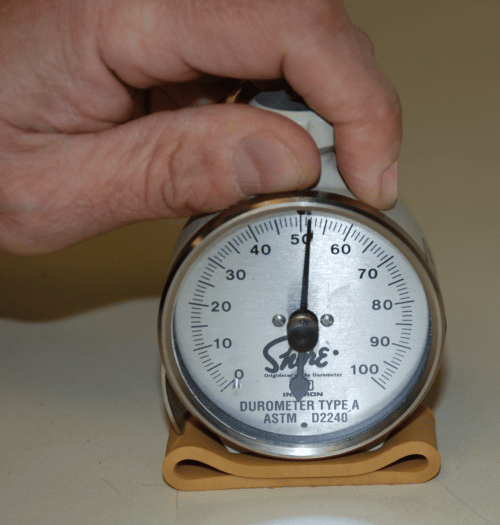
A handheld instrument called a durometer gauge takes this measurement by pressing a standardized indenter into the material and recording the hardness value.
Rubber hardness is typically expressed using scales developed by Albert F. Shore. As a result, these values are commonly referred to as Shore hardness.
Common Shore Hardness Scales
Several Shore scales exist, but the most relevant for rubber and elastomers are Shore 00, Shore A, and Shore D. Shore A is the most widely used hardness scale for solid rubber materials, while very soft sponge and foam materials are more appropriately measured using Shore 00.
Shore 00: Used for very soft rubber and sponge materials
Common in sponge rubber, foam, and low-density elastomers where Shore A is too firm to measure accurately. Shore 00 uses a different scale designed for softer materials, allowing more accurate measurement of sponge and foam compounds that would register near zero on the Shore A scale.
Shore A: Used for most flexible rubber materials
Common for seals, gaskets, rubber bands, and molded elastomer components
Shore D: Used for harder plastics and rigid elastomers
Applies when materials are significantly firmer than typical rubber compounds
Typical Shore A Hardness Range
Rubber compounds can vary widely in hardness depending on formulation and application requirements.
Shore A | Relative Feel | Typical Uses |
20-30 | Very Soft | Cushioning and vibration isolation |
40-50 | Soft | Flexible seals and gaskets |
60-70 | Medium Firmness | General-purpose rubber components |
80-90 | Hard | Wear-resistant parts |
Even a change of 10 durometer points can significantly affect how a rubber part performs in service.
Why Durometer Matters
In practice, selecting the correct hardness helps ensure rubber components function properly within their operating environment.
Durometer affects several key performance characteristics:
Compression and Sealing
Softer materials conform more easily to surfaces, which can improve sealing performance in gaskets and seals.
Flexibility
Lower durometer compounds bend more easily and are well suited for applications involving movement or repeated flexing.
Wear Resistance
Higher durometer materials typically provide better abrasion resistance and durability.
Load Support
Harder materials maintain their shape better under pressure and may be preferred for structural rubber components.
Because of these factors, durometer should always be considered alongside material type, temperature conditions, and chemical exposure.
How Durometer Is Specified
When ordering custom rubber parts, engineers typically specify durometer with a tolerance range.
A common specification might appear as: 60 Shore A ±5
This means the target hardness is 60 Shore A, with an acceptable variation of five points in either direction. These tolerances allow for normal variation in rubber compounding and manufacturing while maintaining consistent performance.
Durometer and Elastomer Type
Hardness alone does not determine how a rubber material will perform. Different elastomers can be formulated across a wide range of durometer values.
For Example:
- Silicone can range from very soft cushioning grades to firmer compounds used in industrial applications.
- EPDM is often produced in mid-range hardness levels for weather-resistant seals.
- Viton® compounds combine moderate hardness with strong chemical resistance.
Two materials may have the same durometer but behave very differently depending on their base polymer and formulation. For this reason, selecting the right elastomer involves evaluating the durometer alongside environmental and performance requirements.
Frequently Asked Questions About Durometer
What does durometer mean in rubber?
Durometer refers to the hardness of a rubber or elastomer material, measured by its resistance to indentation. It indicates how soft or firm a material is and helps determine how it will perform in sealing, cushioning, and structural applications.
What is Shore hardness?
Shore hardness is the standard scale used to measure rubber hardness. The most common scale for elastomers is Shore A, which measures softer flexible materials. Harder plastics and rigid elastomers may be measured using Shore D.
What durometer is considered soft rubber?
Rubber materials below 40 Shore A are generally considered soft. These compounds are often used for vibration isolation, cushioning, or flexible sealing applications.
What durometer is best for rubber seals and gaskets?
Many seals and gaskets fall within the 50 to 70 Shore A range, which provides a balance between flexibility and durability. The ideal hardness depends on the application and operating environment.
Can two rubber materials have the same durometer but perform differently?
Yes. Two elastomers can share the same hardness but behave differently because of their base polymer, additives, and formulation. Properties such as temperature resistance, chemical compatibility, and compression set vary by material.
Need help selecting the right rubber hardness for your application?
Our team works with engineers and buyers to review material options and durometer considerations for custom rubber components. Contact us to discuss your requirements or request a quote!