
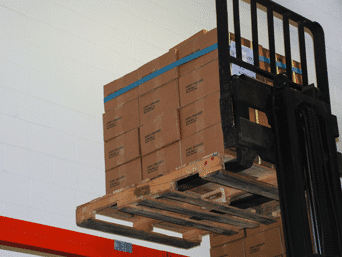
Achieving Cost Efficiency During Internal Pallet Transport
In the ever-evolving landscape of sustainable practices and cost optimization, the choice between using rubber pallet bands and stretch wrap to secure pallet loads emerges as a crucial decision for businesses. The following analysis demonstrates the compelling financial and environmental advantages of adopting pallet bands, highlighting significant cost savings over a span of one year. This comprehensive exploration encompasses not only the impact on labor costs and efficiency but also the eco-friendly benefits of reducing plastic waste and supporting sustainability goals.
The Business Case for Rubber Pallet Bands vs. Stretch Wrap
The Costly and Inefficient Way: Securing Pallets with Stretch Wrap
Production and warehousing facilities often move as many as 50 pallets/day (i.e., 1000 pallets/month over 20 workdays), securing pallets for light transportation from receiving or production to Quality Inspection, and, from there, to either outbound shipment, or to storage and order picking. During this process, pallets are typically wrapped with stretch wrap at least once, and often twice, as illustrated on the flow chart below:
Since one stretch wrap roll lightly wraps about 7 pallets, 50 pallets require approximately 7 rolls of stretch wrap per day, if wrapped once after production; and 14 rolls if re-wrapped after inspection as well. At the typical cost of stretch wrap of about $16 per roll, this represents an estimated cost of $112/day (or $2.24 per pallet) for 50 pallets, equaling to $2,240 for 1,000 pallets per month if wrapped once, and $4,480 when wrapped twice. This translates to an annual stretch-wrap cost of close to $27,000-$55,000 per year, depending on whether the loads are wrapped once or twice.
The Smart and Cost-Effective Way: Utilizing Rubber Pallet Bands
When securing pallet loads with pallet bands during internal transport, the wrapping (and potentially re-wrapping) of loads in stretch wrap can be eliminated. Most standard pallets can be quickly secured with just one or two bands.
Initial Investment and Reusability
The initial investment in reusable rubber pallet bands, at a cost of just about $1.25 each (depending on order volume), is not only lower than the stretch -wrap cost per pallet, but considering their reusability, they quickly prove their cost-effectiveness. Unlike stretch wrap, which is disposed of after each use, pallet bands can be utilized repeatedly for an extended period of 1.5 – 2 years.
In the case of a company moving 50 pallets / day, the related cost can be as little as $50, and realistically less, depending on how many pallets are being transported at one time. Over a period of one year, as the prior calculation shows, the cost savings over stretch wrap can be tremendous.
Impact on Labor Costs and Efficiency
Using pallet bands for securing pallet loads offers significant advantages in terms of speed, cost-efficiency, and worker satisfaction. Unlike the stretch -wrap process taking several minutes, requiring skilled labor and/or equipment, applying a pallet band takes a few seconds by one worker, without specialized tools. This process not only saves labor time and costs but also simplifies work, reducing safety risks. The ergonomic benefits improve employee satisfaction, labor time and costs, and result in enhanced productivity, and a safer, happier workforce.
Environmental Benefits
Aside from financial gains, embracing rubber pallet bands aligns with sustainability goals by mitigating plastic waste. Unlike stretch wrap, which generates disposable plastic waste with each use, pallet bands contribute to a greener environment through reusability and minimal waste generation.
In Conclusion
Considering the financial, environmental, and operational aspects, the choice is clear: rubber pallet bands are a compelling alternative to stretch wrap.
By embracing pallet bands, production and warehousing facilities cannot only optimize their operations but also contribute to a more sustainable future.